Vyzrd Insights

Intelligence for the transitions ahead.

Research, perspectives and evidence on how AI adoption, climate change and energy security are reshaping companies, financial markets and economies.

AIClimateEnergyIntegrated Transition

The most important effects are rarely visible in isolation.

AI changes energy demand and capital allocation. Climate and energy conditions shape the economics of technology and infrastructure. Policy choices move through companies, sectors, employment and investment before they become national outcomes.

Vyzrd’s work examines these connections from the company outward, translating complex signals into financial, operational, workforce and policy consequences.

The aim is not commentary on change. It is sharper foresight about where value, vulnerability and strategic advantage are moving.

Three lenses on a changing economic system.

A selective view of the questions behind Vyzrd’s analysis. Further research, evidence and collaboration outputs are available in conversation.

01AI · Value

AI is not one exposure. It is a reshaping of value.

The important question is not whether a company is exposed to AI, but how adoption changes revenue, cost, investment, workforce and competitive position over time.

Explore the AI lens
02Climate · Capital

Climate analysis becomes useful when it enters the financial decision.

Physical impacts, transition choices and resilience investments matter differently when translated into cash flow, asset value and capital allocation.

Explore the climate lens
03Energy · Competitiveness

Energy security is now a company and economy question.

Affordability, reliability, infrastructure and dependency increasingly shape operating resilience, investment choices and national competitiveness.

Explore the energy lens
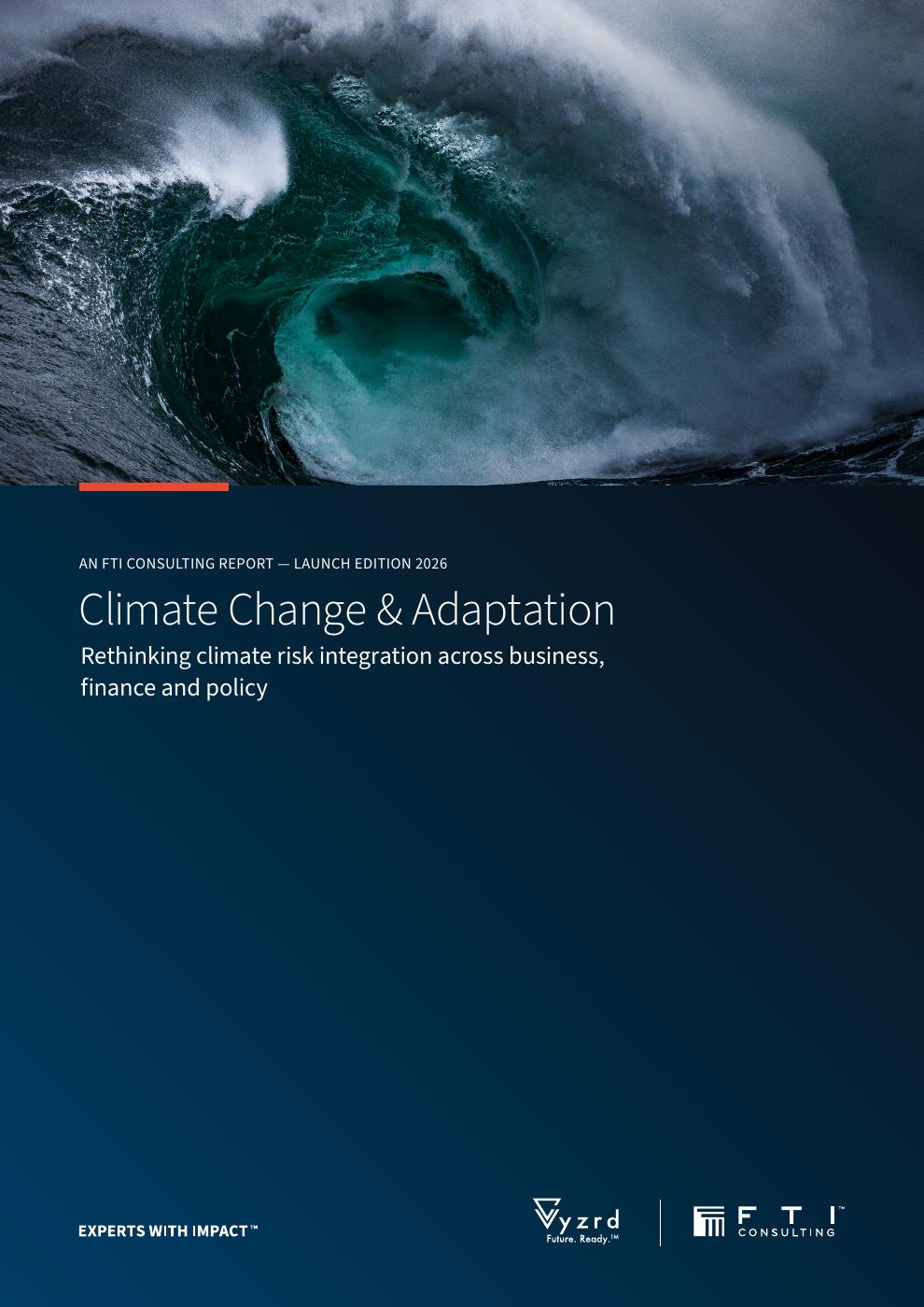
Climate Change & Adaptation 2026 report cover

Joint Research · FTI Consulting + Vyzrd

Climate Change & Adaptation 2026

Rethinking climate risk integration across business, finance and policy.

The study tests what conventional climate-risk approaches can miss when physical exposure is analysed without the full transition and company-level transmission mechanism.

148Global companies$31.4tnAggregate market capitalisation15 yearsForward horizon100,000Simulations per scenario
Open the report

Research Insight · FTI Consulting + Vyzrd

Climate risk can be mispriced when the model stops at physical exposure.

7.7% vs 2.0%Average climate exposure in the integrated 15-year analysis compared with a conventional physical-risk estimate used as a reference point.

The difference does not arise from a more dramatic climate-science assumption. It comes from tracing more of the transmission mechanism: transition policy, technology, market response, operational constraints and company strategy alongside physical risk.

The finding is portfolio-specific, scenario-dependent and not a universal market estimate. Its importance is methodological: incomplete scope can create false comfort even when the calculation itself is technically sophisticated.

Decision implication

Ask not only whether a climate model is rigorous, but whether it includes the channels through which climate change can alter cash flow, capital needs and competitive position.

Source: Climate Change & Adaptation 2026Open report

Integrated Transition · Research Finding

The portfolio average is rarely the decision.

The joint study found climate exposure varied by factors of 3 to 4.5 within sectors. What matters is the dispersion, its drivers and what it changes.
The Decision Question

What is hidden by the average, rating or historical view?

Explore the company-level lens

Questions we believe deserve better answers.

Our agenda evolves with the decisions facing boards, investors, policymakers and operating leaders.

01

AI Adoption

Where will adoption create durable value rather than temporary efficiency?

Diffusion, investment, operating consequences, workforce change and business-model advantage.
02

Resilience & Adaptation

Which risks require protection, adaptation or a different allocation of capital?

Physical exposure, transition pathways, supply chains, resilience economics and financial consequence.
03

Energy Security

When does energy dependence become a strategic disadvantage?

Cost, reliability, infrastructure, transition readiness, industrial capability and economic security.
04

Company to Economy

How should company evidence change a portfolio or policy decision?

Aggregation, dispersion, sector transmission, policy effectiveness and national economic development.

From a new idea to a decision-useful finding.

Not all valuable intelligence belongs in the same format. Vyzrd combines public thinking with deeper analytical and client work.

01

Research & Perspectives

Ideas that reframe a decision

Original thinking on how transition forces change companies, markets, sectors and economies.
02

Methods & Analytical Notes

How a complex question becomes measurable

Selected explanations of analytical boundaries, financial translation, scenarios and interpretation.
03

Case Evidence & Collaboration

What the intelligence changes in practice

Anonymised applications, joint research and client-relevant evidence, shared where permissions allow.
Selective by Design

The public page represents only part of Vyzrd’s thinking and evidence base. Additional research, methods and applications may be shared subject to relevance, permissions and confidentiality.

What transition question should we examine together?

Explore a research collaboration, invite a Vyzrd perspective or discuss evidence relevant to your mandate.

Start a research conversation